SuperWAHM, Expert Business Planning for work at home moms

SuperWAHM, Expert Business Planning for work at home moms

A Pity Party and Bad News about Blogging

If you're new here, you may want to subscribe to my RSS feed. Thanks for visiting!

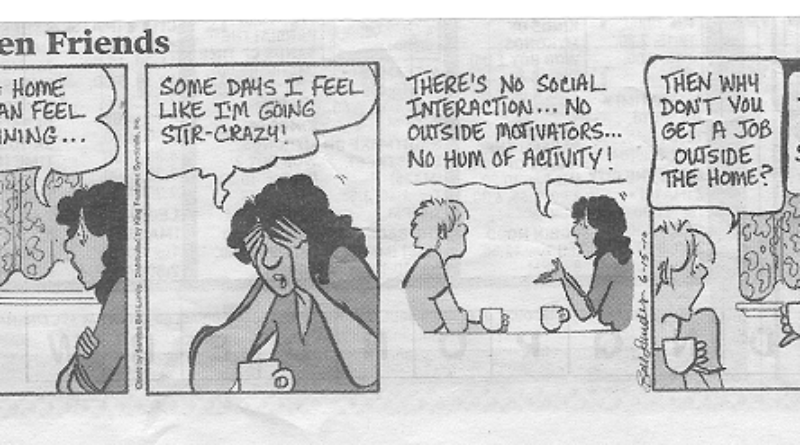
Hubby brought this cartoon home from work several weeks ago.  I had intended to post it earlier with quite a few LOL and HA HA HA’s  and ROFL, but never quite got around to it.

Lately though, I’ve been feeling both sides of this.  The Darling Daughter, 12yo, has been on school holidays for the last two and a half weeks.  Hubby was home ‘sick’ last week with a bad back, and a couple of days this week with the flu (no, not man-flu thankfully, just ordinary flu).

So in the last few weeks I’ve launched the Two Hour Business Plan in the middle of finding time for a 12yo on holidays, looking after an injured/sick husband and then the lovely generous man (hear the sarcasm there?) decided to pass his revolting germs on to me.  Gee, thanks honey.

Self Pity and Woe Is Me is not what today’s post is about though.  Today I thought I’d have a chat about blogging with a business and list some resources that I use.  Some of the links are affiliate links, so if you end up buying any of these I might make enough to buy a cup of coffee, with cream.  Maybe.

Business blogging

I’m going to assume that everyone reading this knows what a blog is and what RSS is.  If not, feel free to email me and ask.  No, it’s not a silly question and you wouldn’t be the first person to ask me.

What’s your blog’s purpose?

Blogging is really useful for your business but it’s not a golden ladder leaning against the wall of huge profits.  It takes time, effort, technique and purpose.  It can also be a huge waste of time for very little ROI (Return On Investment).

Before you go putting all that work into your blog, you have to know why you’re doing it.  Here’s some of the things that a well-written blog can do:

- attract potential customers

- improve your website’s SEO (as long as the blog is on the same domain as the site)

- show people that you know what you’re talking about

- build a community of like-minded people through comments and discussion

- advertise sales, specials, new products

Know why before you start

Too many people jump into blogging for their business without a clear direction and purpose for it.  Just like everything else in business you need to know what result you’re working towards, so you know when you’re on track and if it’s working or not.

Know what you’re doing and why, and then aim every single post towards that purpose.

Readers aren’t buyers

I’m mainly talking to those who sell a service here, although this is still true – albeit to a lesser extent – for those who sell physical products.

Your blog readers aren’t your clients.

The majority of people who read your blog, subscribe to your RSS, comment on your posts – they’ll never buy from you.  This tends to be a shock for a lot of people, it sure was for me, when you’ve put in hours and hours and hours writing posts and then you realise that the readers aren’t actually buyers.

The majority of your readers are there for the free content.  There’s nothing wrong with that, and business blogging is still a great way to spread the word of what you do.  But if you’re looking at several thousand readers and wondering why they’re not buying – welcome to reality.

Readers don’t look at your website

The majority of readers never visit your website after the first hit, when they subscribe to your RSS.  So you can update your site to your hearts content, fill it with ads, promote every product under the sun and your readers still won’t know about it.

If you want your readers to know something, put it in a blog post with a powerful headline.

Partial feeds mean non-readers

So when a lot of people realise the above fact they decide to make their RSS feed only partial, meaning that RSS subscribers will see the first paragraph and have to click through to read the remainder of the post on the website.  Yay!  More hits on the site, better SEO and people see your site and ads, yes?

No.

Statistics show that partial feeds actually reduce readership.  Your first paragraph is going to have to be absolutely riveting and compelling to get people to click through.  Most readers won’t bother.  But if you have a full feed in your RSS – meaning the entire post is there in the reader or email – then most people will read it.

So why bother with blogging?

It’s a pretty depressing picture here isn’t it?  The readers don’t buy, they don’t visit the website and they don’t read partial feeds.  Why bother putting the effort in?

Because blogging will draw more people to your site.  It shows people what you can do and gives them confidence in you.  Used properly, blogging will attract the right people and get them recommending you.  It’s a great tool, but that’s all it is, a tool.

Use blogging wisely and with a clear purpose, and it will help grow your business.

Blogging Resources

Here’s some resources to help you get the most out of your blogging.  They’re all ebooks that I have bought and used myself.

31 Days to Build a Better Blog

31 Days to Build a Better Blog is a downloadable e-book designed to help you revitalize your blog by giving you 31 tasks that will all help to turn it into the page view powerhouse you’ve always dreamed of.

Each day in the project contains:

A Task – something to DO that day.

Teaching – each day you’ll be given great instruction on both the WHY and HOW of the task of the day.

It’s normally $39 but when I checked the link for this post I noticed it’s only $19.95.  I have no idea how long this price is valid for though.

On a side note, I’m looking to run a blogging workshop during August for those who are interested in developing their blogs using this ebook.  It’ll be free (but you have to purchase the ebook), and I’m still working out the details.  If this sounds like something you’d be interested in please let me know in the comments.

Beyond Bricks and Mortar

Taken from the Beyond Bricks and Mortar sales page:

The Practical Strategy to market your Offline business using Online tools

Beyond Bricks and Mortar gives you the solid footing you need to access practical, useful information on how to blog for your business – when your business isn’t online.

Beyond Bricks and Mortar fills the gap when you’re standing confused on the edge of the online world, unclear on how to bridge it for your physical business, and wondering who’ll tell you how to do that.

This is an amazing book written for those who have physical businesses with an online presence.

How to Build a Professional Blog

How to Build a Professional Blog – the Quick Start Guide to Plan, Launch and Profit with your own Successful Blog.

$47 value, and absolutely free.  Gotta love that!  :-)

.

Why Info Products cause ‘stuckedness’ and how to get unstucked

Hi, My name is ‘insert your name here’ and I’m an Info product addict

We’ve all done it.  Bought great info products – ebooks, audios, pdfs, ecourses etc – that are highly recommended and guaranteed to change our lives and send business through the roof.

We all have our favourite teachers, and if they recommend something as being great then we have to get it, right?  Because it will help us grow our business, right?  So we buy more products.  And more.  And we keep on buying.  And downloading and saving them to the hard drive.

You know that folder(s) on your hard drive that’s full of ebooks, video’s, downloads, pdf’s etc that you haven’t looked at since the day you bought them?  How do you feel when you look at that folder?  Guilty?  Upset? Overwhelmed? Waste of money?

Yeah, all of those feelings, right?  Let me tell you a secret – you’re not alone.  Really.  Many, many people have a stash of info products and have never looked at them.  I’m not going to tell you how much I’ve paid over the years for courses that I’ve never started, let alone finished.  And hopefully my hubby won’t ask either….  I used to be as guilty as anyone else on this one.

There ain’t no magic bullet

People buy information products in the hope that ‘this one’ will be the magic bullet that rockets them to instant stardom, money and orders pouring in, clients on waiting lists, kudos on the ‘net.  And it doesn’t happen.

No product is going to do this for your business.  None.  Not any.  Because all those info products, they’re just tools.  You have to use them, and use them in the right way.

So why buy information products?

Because they’re useful and will really help you grow your business.  If you use them properly.  The problem is that people often don’t use them properly, if at all.  They download them, save them, and plan to get to them soon.  Unfortunately ‘soon’ never arrives, the novelty fades and the lonely product sits there unused.

So you get stuck into them and start reading

Learning is good, yes?  The more you learn the better you’ll be at running your business, yes?  Sorry, but the answer to that is often a no.

Too much information is nearly as bad as no information.  When you do decide to get stuck in and work through the courses and ebooks you end up with a head full of ideas and no place to start.

Information overload is very real and paralysing.  When you’ve got a head full of ideas all bouncing around, and more information being packed in on top, it’s like being in a room crammed full of people all talking at the top of their voices.

Step outside with me

It’s time to get out of the room.

Turn off the noise.

Focus on just one thing.

Realise there is no magic bullet.

The answer to information overload is…

Taking action.

Give your mind a break – chances are that you’ve already read enough ebooks and know what you need to know.  See, we get so caught up in ‘learning’ that we stop ‘doing’.  We think we have to do things perfectly, and know everything about it, before we can start.

It’s true that we do need to have a certain level of knowledge in order to run a business.  It becomes a problem when we think that we have to know everything in order to run a business.

Focus on one thing and put it into action

So here you are – you’ve got a stack of info products, all useful, all highly recommended, and I’ve just told you to stop reading them. Here’s what you need to do to break out of the information overload and get your head right.

Firstly do a brain dump.  Every idea, every thought about your business, get it out of your head.  Write down the ideas.  Paper or on the computer, doesn’t matter.  Mind map if it helps.  Just get them out of your head.  Then save it somewhere so you can find it later.

Back to the information products.

Pick one.  Just one.  And work through it – do all the exercises or worksheets as you go.  Apply every technique in it to your business.  Set aside an hour a day to do this.  It’s not a race, take your time.

When you’re finished with the first info product, take a break for a couple of days.  Then pick another one and work through it the same way.  Every exercise, every technique.  Rinse and repeat.

Still don’t know where to start?

If you really can’t pick just one info product or you don’t know what you’re trying to do, I recommend starting with our Quick’n’Dirty Business Plan ebook.

Writing out a business plan will give clarity and direction – and from there you’ll have a better idea of what you need to do for your business.

Leave a comment and tell me what you decide to work on and how you’re going, ok?

How to Think About Business Expenditure

A client recently asked me the following question, and I’m reprinting it (expanded a little from my original email answer) here with her permission. This is an issue that we ALL have to deal with – “How much should I invest into different areas of my business?”

.

.

One thing I would like to know is what percentage of your money received from your business should go to what? For example, after you pay your recurring bills, what percentage should you set aside for marketing, for continuing education, and for taxes and for yourself to use as income for your household. I don’t know if there is a definite answer for this but some sort of guideline would be great so that I can create good money habits.

Here is what I replied:

I’ve heard a lot of numbers tossed around, like 20% of profit goes back into marketing, you should be spending around 10-20% on education, (I think those were the figures) but to be honest it’s a very individual decision.

Ideally you should have a budget forecast as part of your business plan. In an ideal world that would happen, and you’d stick to it and/or have more profit than was forecast and less expenses. But we live in the real world where things are neither so simple nor so black and white.

Some questions for you to consider:

How is your household budget? If you’re scraping to have enough to pay for groceries then that’s where your business money is going to go. Even though they’re in separate accounts, (you DO have a separate business account, don’t you?) if you’re struggling financially then that’s what you’re likely to spend it on. Your money habits in your personal life will be the same as your money habits in your business.

When that’s sorted out:

Assuming your personal household budget is in good shape and you’re not scraping from week to week:

How much do you have to put aside for GST/VAT or other taxes? Put it in a separate account until you have to pay it. Put away more than you think you’ll need and for heaven’s sake don’t touch it for anything else. The ATO/IRS/whatever your country’s tax office is called will chase you down and make your life h**l if you are short on your taxes.

Make sure you have enough aside to pay any ongoing costs such as stationary, coffee with clients, website hosting, phone or fax accounts and any other recurring type expenses. Put that away as well in a separate account if you can – you don’t want to have a hundred different accounts but a tax account, a bill-paying account and a general business account are fine to manage.

Then it’s the hard decisions – the how much do I put into marketing, education etc.

Depends what you need

Does your marketing plan include a lot of costly advertising? Marketing will be higher. Is your marketing plan mainly free stuff online? Much lower cost. You don’t HAVE to put a lot of $$$ into your marketing, there are ways to market for free or low cost. However, for some types of businesses, they need to be advertising etc.

Only you can say how much your marketing budget should be. Time wise, you should be putting as much time and effort into marketing as you possibly can.

Education is the biggie for most businesses, WAHM or not. You could spend thousands and thousands on education and not bring a single extra client in.

This comes back to your long term plan for your business – where do you want it to be in one year, three years, five years? What do you need to learn in order to get there?

What skills do you need that will increase your value to clients? Will those skills justify the cost? Are you in the catch-22 of needing a skill to make money, but can’t afford to pay for the course? (time to drink the cool-aid and sell the kids)

Also, you can’t forecast a lot of what you’ll need to learn because technology changes so fast. You may have to pay to keep current, you may be able to find it free. But there’s no point thinking that you’ll decide everything as you go along, you have to have somewhere and something to aim for so you have a measuring point to aim at to decide if a particular skill or course will help you or not.

Everyone’s answer is individual

It really comes down to a combination of your personal situation, your goals for yourself and your business and what you’re doing at the time. There’s no definitive answer that suits all businesses and business models.

I sent this to her with the comment “I hope this helps” and she replied back “No this didn’t help at all. You are suppose to say you have to do X Y and Z. Just kidding, this was very informative actually. The best information I’ve received so far on searching for answer to this kind of question.” LOL.

Why a Business Plan Will Save Your A$$

Let’s go on a holiday

Picture this:

It’s a Saturday and you’re enjoying a peaceful sleep in (you know, those things you had before you had kids).  And your darling hubby bursts into the room and says “Honey, get dressed!  We’re going on a holiday!”

“When?” you ask, as you crack open one sleepy eye and try to process the sentence through a haze of sleep-induced blurriness.

“Right now” he says “Cmon, the kids are in the car waiting”

So you get up and get dressed, he assures you that you don’t need to pack “It’s all taken care of”, hop in the car and off you go.

“So where are we going?” you ask nervously, thinking of all the appointments and plans in your calendar for the next week.

“On holidays” he replies cheerfully.  And HE sure seems to know where you’re going, even if you don’t.

“But where on holidays?  For how long?” this really isn’t feeling right to you.

“Wherever we end up.  And I don’t know, how long are holidays normally?” Hubby is starting to seem not quite so darling and a bit more annoying every minute now.

“So what are we going to do there?  What kind of clothes did you pack?” Maybe that will give a clue to where he’s taking you and for how long.

“We’ll do whatever is happening when we get to a holiday somewhere.  And I didn’t pack anything, we’ll sort that out as we go” is the cheerful reply.

Ok, that scenario is nuts

Really, nobody sensible would do that, would they?  Then why do so many businesses get treated that way, with a happy-go-lucky “I’ll sort it out when and if it happens” attitude.  Why not plan for as much as possible – both good and bad – and prevent as many problems as you can?

Approximately 98% of WAHMs don’t have a business plan.  So the chances are pretty good that if you’re reading this and you’re a WAHM then you don’t have a business plan, or at least not a current one.  Am I right so far?

And by business plan I mean one written down on paper, not just in your head.  Having a plan in your head is pretty much worthless.  It has to get out of your head, onto paper, and have foundations and strategies put in place to execute it.

If you’re one of the rare few who DO have an up to date business plan then well done.  Pat yourself on the back and take a bow.  You’re a rarity and well above average.  It’s also likely that you’ve been around for a few years and experienced first hand the advantages of a business plan.

Why WAHMs don’t write business plans

Here’s a list of the most common reasons that I hear around not writing a business plan:

  • It’s too hard
  • I don’t know what to put down
  • I don’t need one for a home business
  • It’s in my head
  • I don’t have time
  • I had one but it didn’t work
  • I tried and it was too complicated
  • I know what I’m doing
  • It started as a hobby and I never got around to it
  • What’s a business plan?

Planning your business is like planning your family

Think about this – there’s a lot of similarities between planning your business and planning your family (although I won’t insist on you writing down your family planning).

  • Some people plan their families years in advance and the timing works out perfectly for the families and they grow precisely in line with their plans
  • Some people get a family when they least expect it – what started as a bit of playing around suddenly takes on a life it of it’s own and you’re responsible for it
  • Sometimes people will have a great family, and suddenly something outside their control happens and the unit is damaged, separated and destroyed.
  • Some people plan for a steady increase in their family, but nature ‘happens’ and they get double or triple what they were expecting
  • Or you hook up with someone, and suddenly it’s a package deal and you get fully-developed stepkids, full or part time, thrown into the bargain
  • Some people plan to have a family, but no matter what they try and no matter how much money they put into trying – nothing happens, their family never grows and they eventually give up trying and go on with other life.

‘Business plan’ is not a four letter word

All those reasons we saw above are just excuses.  None of them are valid, legitimate reasons when you really get down to it.  If you’re going to have a business then treat it as a real business, plan for growth and development and make it happen.

Want to get off to a quick start?

If you’re in the 98% of WAHMs who don’t have a current, written down business plan then check out our No-Plan-Preneur Quick’n’Dirty Business Plan guide.  Priced at only $6.95 and designed to be both fast and easy, this ebook will give you a quick shot of motivation and get you  and your business headed in the right direction.

Set Yourself Apart with Planning – free Audio download

Here’s the first freebie for January!

It’s half hour audio on how you can set yourself apart from everyone else by planning your next 12 months.

Yes, I know every man and his dog on the internet are doing goal setting right now, and I’m not going to apologise for being one of them.  Because it’s so important.  This audio isn’t just about setting goals  it’s about strategising and putting a solid foundation underneath them that will help you actually reach those dreams.

In the audio I talk about:

  • Developing your goals
  • making them challenging and personal
  • Suggestions for what to do when you don’t know what goal to set
  • Strategising, and planning
  • Getting your subconscious to help by putting your goals on autopilot

We all have dreams for our businesses.  Every single one of us. Set yourself apart from the rest and do something solid and effective towards achieving your dreams.  Download this audio and listen to it.  Do the exercises in it.  Practice visualising your goals.  And see them become reality in your WAHM business.

This audio is a free gift to you, to assist you in achieving your dreams and goals for your business.  Please share it around, send the link to your friends, post it on forums, twitter it….

.

Set Yourself Apart With Planning (129)

Right click the link and “Save As” to download to your hard drive.

.

I wanted to let you know I listened to your mp3 last week about business goals and it’s really helped me.  I was one of the ones who just had ‘do more with my business’ as a goal for the year, but after listening to the file I was able to specify exactly what I want, and break it down, and so far I’m keeping up with it.  So thank you for that!
Melissa Smith

Related Posts with Thumbnails
Powered by WishList Member - Membership Software