A Pity Party and Bad News about Blogging

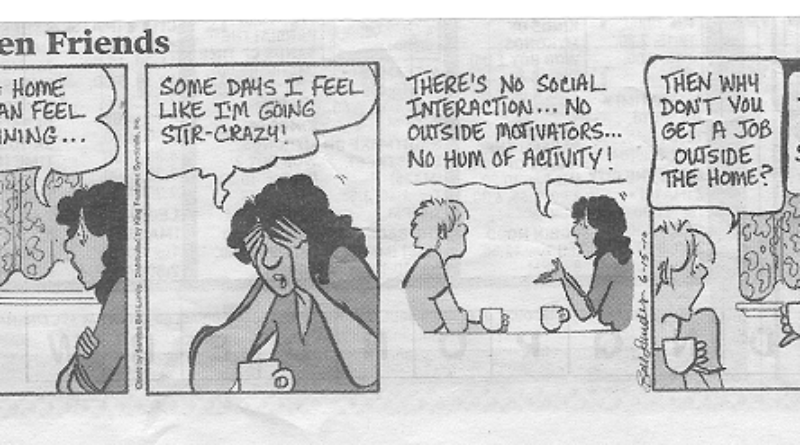
Hubby brought this cartoon home from work several weeks ago. I had intended to post it earlier with quite a few LOL and HA HA HA’s and ROFL, but never quite got around to it.
Lately though, I’ve been feeling both sides of this. The Darling Daughter, 12yo, has been on school holidays for the last two and a half weeks. Hubby was home ‘sick’ last week with a bad back, and a couple of days this week with the flu (no, not man-flu thankfully, just ordinary flu).
So in the last few weeks I’ve launched the Two Hour Business Plan in the middle of finding time for a 12yo on holidays, looking after an injured/sick husband and then the lovely generous man (hear the sarcasm there?) decided to pass his revolting germs on to me. Gee, thanks honey.
Self Pity and Woe Is Me is not what today’s post is about though. Today I thought I’d have a chat about blogging with a business and list some resources that I use. Some of the links are affiliate links, so if you end up buying any of these I might make enough to buy a cup of coffee, with cream. Maybe.
Business blogging
I’m going to assume that everyone reading this knows what a blog is and what RSS is. If not, feel free to email me and ask. No, it’s not a silly question and you wouldn’t be the first person to ask me.
What’s your blog’s purpose?
Blogging is really useful for your business but it’s not a golden ladder leaning against the wall of huge profits. It takes time, effort, technique and purpose. It can also be a huge waste of time for very little ROI (Return On Investment).
Before you go putting all that work into your blog, you have to know why you’re doing it. Here’s some of the things that a well-written blog can do:
- attract potential customers
- improve your website’s SEO (as long as the blog is on the same domain as the site)
- show people that you know what you’re talking about
- build a community of like-minded people through comments and discussion
- advertise sales, specials, new products
Know why before you start
Too many people jump into blogging for their business without a clear direction and purpose for it. Just like everything else in business you need to know what result you’re working towards, so you know when you’re on track and if it’s working or not.
Know what you’re doing and why, and then aim every single post towards that purpose.
Readers aren’t buyers
I’m mainly talking to those who sell a service here, although this is still true – albeit to a lesser extent – for those who sell physical products.
Your blog readers aren’t your clients.
The majority of people who read your blog, subscribe to your RSS, comment on your posts – they’ll never buy from you. This tends to be a shock for a lot of people, it sure was for me, when you’ve put in hours and hours and hours writing posts and then you realise that the readers aren’t actually buyers.
The majority of your readers are there for the free content. There’s nothing wrong with that, and business blogging is still a great way to spread the word of what you do. But if you’re looking at several thousand readers and wondering why they’re not buying – welcome to reality.
Readers don’t look at your website
The majority of readers never visit your website after the first hit, when they subscribe to your RSS. So you can update your site to your hearts content, fill it with ads, promote every product under the sun and your readers still won’t know about it.
If you want your readers to know something, put it in a blog post with a powerful headline.
Partial feeds mean non-readers
So when a lot of people realise the above fact they decide to make their RSS feed only partial, meaning that RSS subscribers will see the first paragraph and have to click through to read the remainder of the post on the website. Yay! More hits on the site, better SEO and people see your site and ads, yes?
No.
Statistics show that partial feeds actually reduce readership. Your first paragraph is going to have to be absolutely riveting and compelling to get people to click through. Most readers won’t bother. But if you have a full feed in your RSS – meaning the entire post is there in the reader or email – then most people will read it.
So why bother with blogging?
It’s a pretty depressing picture here isn’t it? The readers don’t buy, they don’t visit the website and they don’t read partial feeds. Why bother putting the effort in?
Because blogging will draw more people to your site. It shows people what you can do and gives them confidence in you. Used properly, blogging will attract the right people and get them recommending you. It’s a great tool, but that’s all it is, a tool.
Use blogging wisely and with a clear purpose, and it will help grow your business.
Blogging Resources
Here’s some resources to help you get the most out of your blogging. They’re all ebooks that I have bought and used myself.
31 Days to Build a Better Blog
31 Days to Build a Better Blog is a downloadable e-book designed to help you revitalize your blog by giving you 31 tasks that will all help to turn it into the page view powerhouse you’ve always dreamed of.
Each day in the project contains:
A Task – something to DO that day.
Teaching – each day you’ll be given great instruction on both the WHY and HOW of the task of the day.
It’s normally $39 but when I checked the link for this post I noticed it’s only $19.95. I have no idea how long this price is valid for though.
On a side note, I’m looking to run a blogging workshop during August for those who are interested in developing their blogs using this ebook. It’ll be free (but you have to purchase the ebook), and I’m still working out the details. If this sounds like something you’d be interested in please let me know in the comments.
Taken from the Beyond Bricks and Mortar sales page:
The Practical Strategy to market your Offline business using Online tools
Beyond Bricks and Mortar gives you the solid footing you need to access practical, useful information on how to blog for your business – when your business isn’t online.
Beyond Bricks and Mortar fills the gap when you’re standing confused on the edge of the online world, unclear on how to bridge it for your physical business, and wondering who’ll tell you how to do that.
This is an amazing book written for those who have physical businesses with an online presence.
How to Build a Professional Blog
How to Build a Professional Blog – the Quick Start Guide to Plan, Launch and Profit with your own Successful Blog.
$47 value, and absolutely free. Gotta love that!
.
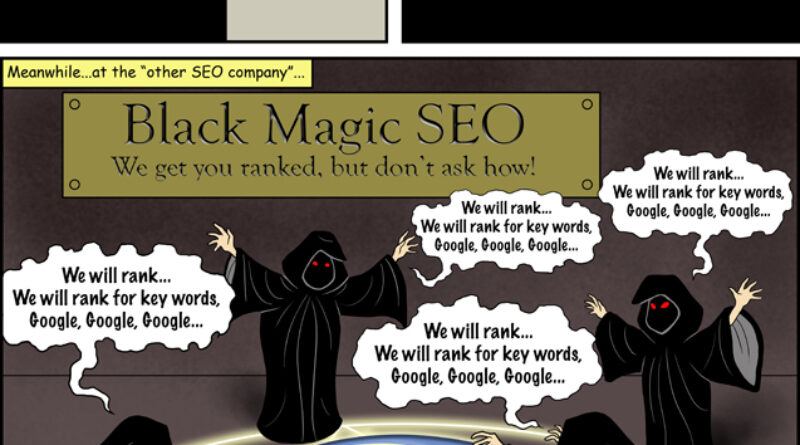
Black Magic SEO vs Logic
.
..
.

Used under Creative Commons Attribution licence, from RankedHard SEO
Hehehehe, found this online and loved it. How true!
(If you’re looking for an easily understandable SEO book, check out IttyBiz SEO School (opens in new window) – fantastic ebook. Leads you step by step through how to set up SEO on your site and why it all works, written in plain english for the non-techie. Note: the price isn’t on the page but it’s $39.00 and worth every cent!)
The 70% Principle: Why You Never Get Projects Off The Ground
Today’s post is reprinted with permission from Psychotactics by Sean D’Souza. This particular article is one I keep coming back to, otherwise I’d be rewriting, re-recording and editing for ever. Enjoy!
The 70% Principle
Have you got eleven seconds to learn a simple principle? A principle that will radically change the way you do things?
You do, don’t you?
Ok, tick, tick, tick….here’s the principle.
It’s called..um…the 70% Principle
So what’s the 70% Principle?
If a job is worth doing, it’s worth doing 70% right.
You can always come back to do the 20% later.
Yes, read it again, and no, the math isn’t wrong.
If you’re going to build a website, a 70% effort is fine.
If you’re going to do a presentation a 70% effort is fine.
If you’re going to bake a cake, for that matter…do you need all the ingredients?
The perfect cake? With all the perfecto ingredients? Or the cake with ’70%’ of the ingredients?
The ‘perfect’ wording on a website? Or the ’70% perfect’ wording on the website?
And nope this isn’t a case for mediocrity
No one is telling you to do crappy stuff. No one’s saying that you need to keep your project unfinished. But in the quest for perfection, most of us never start.
The 70% principle is about getting your best effort out and into the hands of your clients. That you don’t need to start off with a 100%-kaboom-wow-start.
So let’s tell you about our ‘who pushed me?’ start in 2002
We started Psychotactics,in the year 2002, with a 16 page booklet. We called it the ‘Brain Audit.’ And indeedy-doo, it started with just 16 pages. Those 16 pages, we cheekily sold for $20 or thereabouts.
And you know what?
We weren’t trying to keep the pages down to 16 pages, but we certainly weren’t trying to pad up the contents of the book either.
The 16 pages of information were all we knew at the time. And yes, we could have made it 100% perfect, but decided to put our 70% effort out anyyay.
Did I say, put it out? I meant, I got ‘pushed’
You see, I wasn’t keen to sell the Brain Audit. I wanted to get the e-book just right. But I was forced into putting it on the market.
I was forced to putting it on a sales page, by another marketer who promised to promote the book to his audience.
And he never did promote the book
I reminded him. Gently. Then became a bit of a nag. But that promotion never, ever happened. What did happen was that the ‘Brain Audit’ began to sell.
And as it turned out, I was able to add the next 20%,
and the next 20%, and the next 20%.
And yes, the math still adds up
Because all along, that ‘so-called incomplete’ product was selling. And when you think about it, which product or service of yours is ever complete?
As your knowledge grows; as your customers ask more questions; as you apply the concepts in different ways, your product or service gets better all the time.
And today, the Brain Audit is a comprehensive document that not only helps you understand how the customer thinks, but is also the basis for being a member of 5000bc; for doing any of our courses like the copywriting course, product-creation course.
What started out as a ‘who pushed me?’ product, now helps us get thousands of customers. And helps us grow our business considerably from year to year.
Kinda like the iPod, you see
When the iPod came out at first, it was just 10GB (yeah, pathetic ten gigs).
Then it went up to 30GB. And hey, we got video too. Then whoopsy-doo, it was 60GB. And uppity up it keeps going, both in size, features and ease of use.
Where’s the market for the perfect iPod?
There’s no market for the perfect product or service. The product or service that your customers want, is the product or service you have now.
That 70%-perfect product/service, will do fine for your customer.
How can I be so sure?
Could this article have been at least 30% better?
Couldn’t I have found more examples? More case-studies? Put in more details, perhaps? Tweaked my words just so to make it richer, more vibrant?
Sure I could. But you’ve got the point, right?
If a job is worth doing, it’s worth doing 70% right. You can always fix the 20% later.
©2001-2010 Psychotactics Ltd. All Rights Reserved.
Article written by Sean D’Souza.
Wouldn’t you love to stumble upon a secret library of small business ideas. Find simple, yet electrifying ideas,on website strategy, marketing strategies, copywriting, public speaking, article marketing, sales conversion, psychological tactics and branding. Head down to http://www.psychotactics.com today and judge for yourself.
Gender Bias – Alive and Kicking on the Internet
The very charming James from Men With Pens recently directed me towards Technorati’s recently released “State of the Blogosphere 2008” report. This report has been issued yearly since 2004, and the stats and figures it puts out are interesting. The complete report is so large they spread it over six days (so glad I wasn’t the one writing it!).
They’ve also recently emailed out a link for people to complete a survey for “State of the Blogosphere 2009”. If you’re interested in completing it – and if you’ve got a blog then you should be – click here for the survey.
What really struck me about this years report is the obvious gender bias in blogland. Looking firstly at the Introduction and the ‘Segment Snapshot of Bloggers’ the bias is obvious.
Personal Bloggers = 64% male
Corporate Bloggers = 70% male
Professional Bloggers = 72% male
I’m not sure exactly how Technorati defines the difference between ‘Corporate’ and ‘Professional’ bloggers, since over 50% of all three categories say they are in full-time employment. There seems to be no distinction made between full-time employment blogging and full-time employment elsewhere.
Average time blogging = 35 – 38 months. (Three years, give or take a month or two) There’s no instant path to success here. Experience, and sheer tenacity, seems to be a factor in being a successful blogger. Ask any of the A-Listers and they’ll tell you this, there’s no surprise there.
Looking at the “Global Bloggers by Gender” chart, 83% of females and 76% of males have personal blogs, however when it comes to business only 38% of females have a business blog compared to 50% of males.
These figures show something I’ve suspected for awhile. The internet is a man’s world, baby!
Think about it. Name for me a single female A-List blogger. Dooce – maybe? Others – there are a lot of females who are well-known, but not classed as A-Listers. Gender bias is well and truly alive on the internet, and I have to say it irritates me no end.
Why is this? I mean, why is it a man’s world, not why does it irritate me. If you’re a female then I’m sure you know why it irritates me, and if you’re a guy and you don’t get it then you possibly shouldn’t ask.
Honestly, I don’t know. Females are as intelligent as males, we’re as well educated as the guys are. We’re as tech savvy as them. Yet, what we say has less authority. We attract less readers. People question what we say more than they do a guy’s writing. I guess we as a culture haven’t advanced as much past the days of the suffragettes and equal opportunity as we like to think we have.
But you know what? The ‘why?’ is less important than the ‘so what?’. What does this mean for me? What does this mean for my clients, my friends, my peers? What does this mean for your business? The fact is that the internet is male-dominated, so how do we live with that, earn a good income and grow our businesses?
So tell me, what’s your opinion on this? Is it truly a man’s world? What chance does a female have of getting to the top of the blogosphere? Leave a comment and tell us what you think.
Hitting the Wall
I hit a wall last week. Figuratively speaking that is, not an actual wall. You may have noticed there was only one post last week? That wall was one that I’d been warned about, that I’d been told to look for around the six month mark of having the site going and blogging constantly.
I thought I’d missed it. Yay me! After all, I’d been running a coaching business, complete with website, for over four years, why would ‘this’ six month mark be different? And besides, it’s been eight months. I must have missed it, right?
Man, I didn’t even see it coming. That wall just up and hit me right between the eyes last week. Totally unexpected, and frustratingly solid.
It’s the wall of “this is damned hard work” and “I’ve written more in the last eight months for this site than I did in the entire four years of the other website” and the “I’m so sick of sitting down to write/market/tweak/network”. And since it was a busy week in other ways, that wall felt even heavier than it should have.
It’s not that I’ve run out of topics, goodness knows I’ve got topics listed for the next two months and I’m adding to them faster than I’m writing posts. It’s not that I’m not getting results from the website, I’ve got a higher readership than I expected. I’ve got coaching clients contacting. I’ve had people contact me for Joint Ventures, guest posts, links etc. Business is good.
It’s simply the fact of the day to day ‘stuff’ of writing a blog. The glow of initial excitement has faded and gone, it’s no longer a novelty to have a business blog, it’s become the ordinary way to do business. The joy of writing a new post every day or two has disappeared, to be replaced by the mundane-ness of business as usual.
That’s not necessarily a bad thing, it happens to every business owner, and apparently it’s usually around the six month mark. I guess I’m lucky that I made it to eight months before hitting the wall. That was probably simply the fact that I had so much going on in my personal life around then – my husband came home from a six month deployment in the Middle East – that I was able to keep going for a bit longer.
It’s not a bad thing, this wall, in fact it’s a good thing, it’s a significant milestone. This wall is a barrier that filters out the serious business people from the wanna-be’s. If you’re not serious about your business, if you’re not prepared to keep on going long-term, if you were expecting it to be easy, then this wall will stop you.
However if you knew from the start that it was going to be hard work, if you planned your business growth over a long period of time, then like me, you’ll get through this. Or you’ll get over it, under it, around it, whatever it takes. That wall won’t stop you more than momentarily. Or, as in my case, for a week.
I spent that week, apart from writing the one post, looking at what I’m doing and going over my business plan. Was this really what I wanted to keep on doing? Was I doing it the best way, or could I make it easier for myself? It was a real wake-up call, this feeling of hitting a wall, to make me look closely at what I’m doing and what I plan to do.
WAHM Biz Builder has evolved constantly over the last eight months, and it’s still changing. We’ve gone from launching in mid January, a major site redesign in April, another site change in July. I can track the changes and development in my writing from my first post to now. (And I’m so thankful it’s developed, because that first post is really badly written! Ugh!) I’ve run a survey of my readers, who basically said keep going in the same direction, that what I was writing about was what they were interested in reading. I’ve trialled Value Based Coaching. It’s been a great eight months.
I’ve been told there’s another wall that hits around the 12 month mark, and then again at 3 years. This time I’ll be ready for them, and not so surprised when they hit. Apparently this happens to every business, from the A-Listers at the top downwards. They’ve all gone through this and come out the other side stronger and more secure.
Last week is over, the wall is behind me now (thank heavens!) and so it’s on with business as usual. And thanks to last week and taking the time to look at what I’m doing, I now have an even clearer vision for the next year.

The web's business planning expert - just for work at home mums. Together we'll find the time for you to make money.